
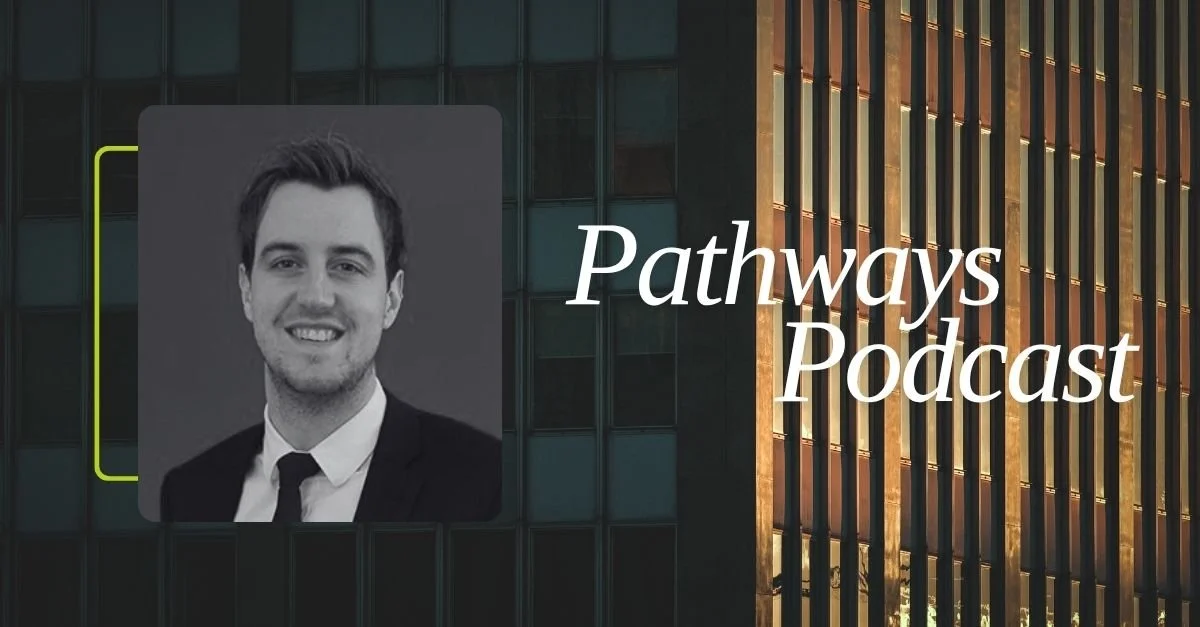
Pathways — Trent Bond, SEN
Summary
Trent Bond’s career has been shaped by a mix of timing, persistence and a genuine passion for sport, ultimately leading him to a role where his professional skillset aligns closely with his personal interests.
His journey through finance has been grounded in building capability across complex, multi-faceted businesses, developing a strong ability to operate across both traditional finance and broader commercial functions.
A defining theme throughout his career is a focus on building high-performing teams with a clear sense of purpose, recognising that culture and alignment are key drivers of long-term success.
At Sports Entertainment Network, he operates within a uniquely diversified media and sports business — spanning radio, teams, events and content — requiring a highly adaptable approach to growth, value creation and navigating a rapidly evolving industry.
Building with purpose
It was a series of fortunate events, paired with a career of dedication and hard work — that led to Trent Bond stepping into the role of Chief Financial Officer for Sports Entertainment Network (SEN). Once a young boy who dreamed of a playing AFL, and now a self confessed Arsenal fanatic — the finance leader has found his place in the sports world, doing what he does best, building high performing teams with purpose.
Liam Killen, Director of Atlas Partners, chatted to Trent about the early days of his career, sliding door moments, and what he’d say to the finance leaders of tomorrow.
Episode transcript
Liam: My guest today is Trent Bond, CFO of Sports Entertainment Network. Trent, thanks so much for joining us.
Trent: Thanks for having me, Liam. I’m looking forward to it.
Liam: Trent, let’s start with your career journey. Can you walk us through how you got to where you are today?
Trent: Sure. My path might be a bit unique. From a young age, I had two ambitions — to either play AFL or become a businessman. AFL didn’t quite work out, so I leaned into the business side.
In Year 12, I secured a cadetship with KPMG, which set the foundation early. I worked full-time while studying part-time, then flipped that toward the end of my degree. After graduating, I returned to KPMG full-time and spent about six or seven years there.
Like many people in accounting, I then headed to London for about 12 months. That experience was probably one of the most important in my career — it pushed me out of my comfort zone and helped me grow both personally and professionally.
Liam: And what happened when you returned to Australia?
Trent: I joined Programmed as a Finance Manager, which was a great step into industry. The business went through a buyout while I was there, so I got exposure to governance, compliance and working in a more complex corporate environment.
From there, I moved to RSEA Safety as Head of Finance. That was an incredible period of growth — the business scaled from around $170 million in revenue to $300 million, and expanded significantly in terms of footprint.
It was a great environment to be part of, particularly navigating growth through COVID.
Liam: And now at SEN — how did that opportunity come about?
Trent: I joined SEN initially as GM of Finance. Interestingly, about a week after I accepted the role, the CFO resigned, which created the opportunity for me to step into the CFO position.
It was definitely a right place, right time moment — a real sliding doors situation — and something I feel very fortunate about.
Liam: Speaking of sliding doors moments, were there any others that stand out in your career?
Trent: There are a couple. One early one was at Programmed. I had a manager who sat me down and told me I had the talent but wasn’t applying myself as much as I could.
That was a big moment for me. It changed how I approached work and also shaped the kind of leader I want to be — someone who supports people but also challenges them to be better.
The second was obviously the move into the CFO role at SEN. That opportunity came unexpectedly, and it’s one I’ve really embraced.
Liam: Let’s talk about SEN. Many people know the radio network, but the business is much broader than that. Can you give us an overview?
Trent: It’s definitely broader than people expect. The radio network is the most visible part — we’ve got stations across Australia — but that’s just one piece of the business.
We also own a number of sports teams, including the Perth Wildcats in the NBL, WNBL teams, a Super Netball team, and teams in New Zealand. On top of that, we have a TV production business, an events and travel division, a talent management arm, and a publishing business.
At the core, everything ties back to our purpose — making a sports fan’s day.
Liam: There’s been a lot of commentary around the business over the past year. Where do things stand now?
Trent: My view is things are rarely as good or as bad as they seem from the outside. There were definitely challenges, but a lot of the progress being made wasn’t always visible.
More recently, we’ve seen some really positive momentum. We’ve reduced debt significantly, improved our financial position, and delivered strong radio ratings — particularly in Melbourne.
We’ve also seen strong outcomes from some of our investments, like the Perth Wildcats, which has delivered a great return. So, the business is in a much stronger position now, with good foundations for the future.
Liam: Where do you draw your inspiration from?
Trent: First and foremost, my wife and daughter. They’re my “why” — they’re the reason I do what I do and what keeps me grounded.
Professionally, I’ve also been influenced by Simon Sinek’s concept of “Start with Why.” It really resonated with me. At SEN, our purpose is making a sports fan’s day, and having that clarity helps guide decisions and build a strong culture.
Liam: How important has your network and mentorship been throughout your career?
Trent: It’s been incredibly important. Melbourne is a small market, so networks matter, but mentors have been even more valuable.
I’ve been lucky to work with people who genuinely cared about my development — both at Programmed and RSEA. Having someone in your corner who supports you, challenges you and helps guide you is invaluable.
For anyone progressing through their career, I’d strongly recommend finding a mentor.
Liam: And finally, what advice would you give to future CFOs?
Trent: Two things. First, people. You’re only as good as the team around you. You need to build strong teams, understand your own strengths and weaknesses, and surround yourself with people who complement you.
Second, the role of the CFO is evolving. It’s no longer just about technical capability — it’s about being a true business partner, working alongside the CEO and helping drive strategy across the organisation.
You need to be able to connect with all parts of the business and bring people on the journey.
Liam: Outstanding advice. Trent, thanks so much for joining us.
Trent: Thanks, Liam. It’s been a pleasure.