
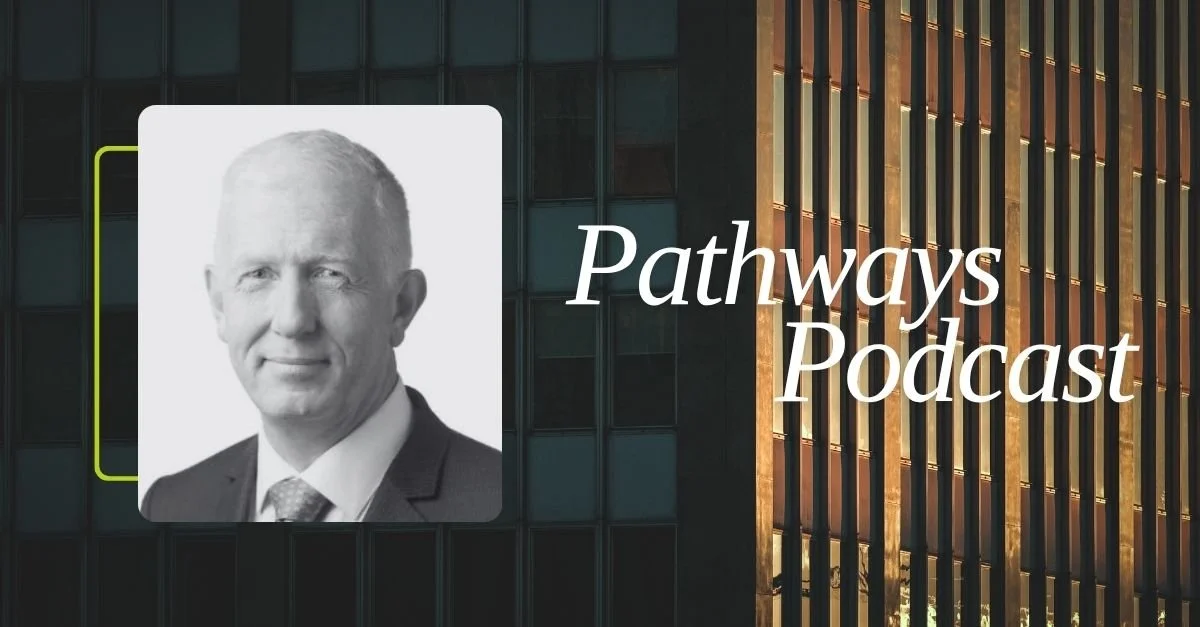
Pathways — Mark Lawrence, Western Health
Summary
Mark Lawrence’s career has been defined by longevity and evolution, spanning over four decades across manufacturing, packaging and now public health — building a breadth of experience that underpins his leadership today.
A key shift in his journey came from deliberately moving out of capital-heavy manufacturing into the people-centric world of healthcare, seeking a fundamentally different environment that challenged how he thought about leadership and impact.
Throughout his career, he has developed a strong belief that leadership is less about control and more about humanity — learning to move away from reactive, command-and-control styles toward trust, vulnerability and continuous improvement.
At Western Health, he operates in one of the most complex and high-pressure sectors, where finance intersects with patient outcomes, and success is driven not just by numbers, but by supporting people, systems and long-term community impact.
From capital to people
Mark gives his raw and honest account of his transition into public health, his experience coming from the commercial sector and how he sees the immediate future playing out across public health. A direct account of his reflection and prediction.
Craig Gorton, Director of Atlas Partners sits down with Mark Lawrence to talk through his rise to CFO in one of the most challenging industries out there. Mark takes us through his journey from product to people.
Episode transcript
Craig: If you could give me a summary of your career to date, including your early days and foundational learnings?
Mark: Sure — the challenge is it spans over 40 years, so I’ll break it into a few key phases.
Early on, I didn’t have a clear passion like engineering or the arts. I knew I’d end up in business, so I pursued a business degree, which led me into accounting.
In those early years, I made plenty of mistakes — that’s probably the biggest takeaway. To be honest, most of my meaningful learning hasn’t come from that period. A lot of what I developed later actually involved unlearning some of those early habits, particularly around management and leadership.
The real turning point for me was joining Amcor.
Craig: What made that experience so impactful?
Mark: Amcor was a fantastic environment. They taught me the technical fundamentals of accounting — process, discipline, and getting things right.
But more importantly, they built a very collegiate culture. You could pick up the phone to anyone across the business and get support. There was a real sense of being in it together, which made a big difference.
That period — probably from my 30s into my 40s — was a major development phase for me. In hindsight, I sometimes think I should have stayed longer, but circumstances at the time meant I moved on.
Craig: And that led you into healthcare?
Mark: Yes. Prior to that, I’d spent my career in manufacturing — which is very capital-heavy. It’s probably 90% equipment and 10% people. Everything is about production, efficiency and output. It’s quite structured and predictable.
I wanted to experience the opposite — a more people-focused environment. So when a healthcare role came up, it appealed to me immediately.
Craig: And was it what you expected?
Mark: In some ways, yes — but in others, it was a real shock.
Healthcare is far more people-centric, but the culture is very different. In manufacturing, there’s a strong focus on accountability and execution. In healthcare, decision-making can be much slower, often driven by committees and layers of consultation.
I’ve spent a lot of my time trying to shift that mindset — encouraging more individual accountability and faster decision-making. You still collaborate, but ultimately someone needs to take ownership.
The other major difference is the influence of politics. In public health, decisions are often shaped by government priorities, which was quite an adjustment coming from the private sector.
Craig: You’ve now spent over 20 years in healthcare. What’s your view on the future of the CFO role in that space?
Mark: It’s going to be very challenging — particularly in the current environment.
There’s significant financial pressure across the system, driven by factors like increased demand, workforce costs, and ongoing investment requirements. At the same time, there’s an expectation to operate within tight budgets.
Over the next few years, I think CFOs in public health will face some very difficult decisions. It’s not an easy role, but for those who enjoy a challenge, it’s certainly a place where you’ll be tested and grow.
Craig: What would you say are the key lessons you’ve learned as a CFO?
Mark: A few things stand out.
First, you need to operate at both a strategic and detailed level. Some people are strong strategically but avoid the detail, while others get lost in the detail and can’t step back. A CFO needs to do both.
Second, you need to truly understand the issues. You can’t just skim the surface — you need to get under the skin of a problem before you can provide meaningful direction.
And third, people management is critical. That’s something I’ve worked on a lot over the past decade.
Early in my career, I was quite directive — telling people what to do. Over time, I’ve learned that asking questions, supporting people and helping them find their own solutions is far more effective.
Being kind, in many cases, is more important than being clever.
Craig: Have you had mentors who influenced your career?
Mark: I had one early mentor who helped me see the potential in an accounting career and guided me through that phase.
Beyond that, most of my learning has come from experience — making mistakes and receiving feedback. One example was being told I was too reactive. That feedback stuck with me, and I’ve worked on being more considered in how I respond.
If you’re willing to listen, people will give you valuable feedback — and it’s up to you to act on it.
Craig: What advice would you give to future leaders?
Mark: Leadership ultimately comes down to being human.
You don’t need to have all the answers. In fact, it’s important to show that you don’t — to be open, to ask questions, and to involve your team.
Creating an environment where people feel supported, where mistakes are allowed and learning is encouraged, is key.
When I started, leadership was very much command-and-control. I had to unlearn that over time. Future leaders should avoid that approach — it’s far more effective to lead with empathy, trust and openness.
Craig: And finally, what’s your favourite book?
Mark: Jack of Shadows by Roger Zelazny.
It’s a science fiction novel with an interesting central theme — the main character is quite self-serving, but ends up helping someone without expecting anything in return, and that act ultimately comes back to help him.
It’s a reminder that doing things for others, without expecting anything back, can lead to unexpected outcomes.
Craig: Fantastic. Thanks so much for joining us, Mark.
Mark: Thanks, Craig.