
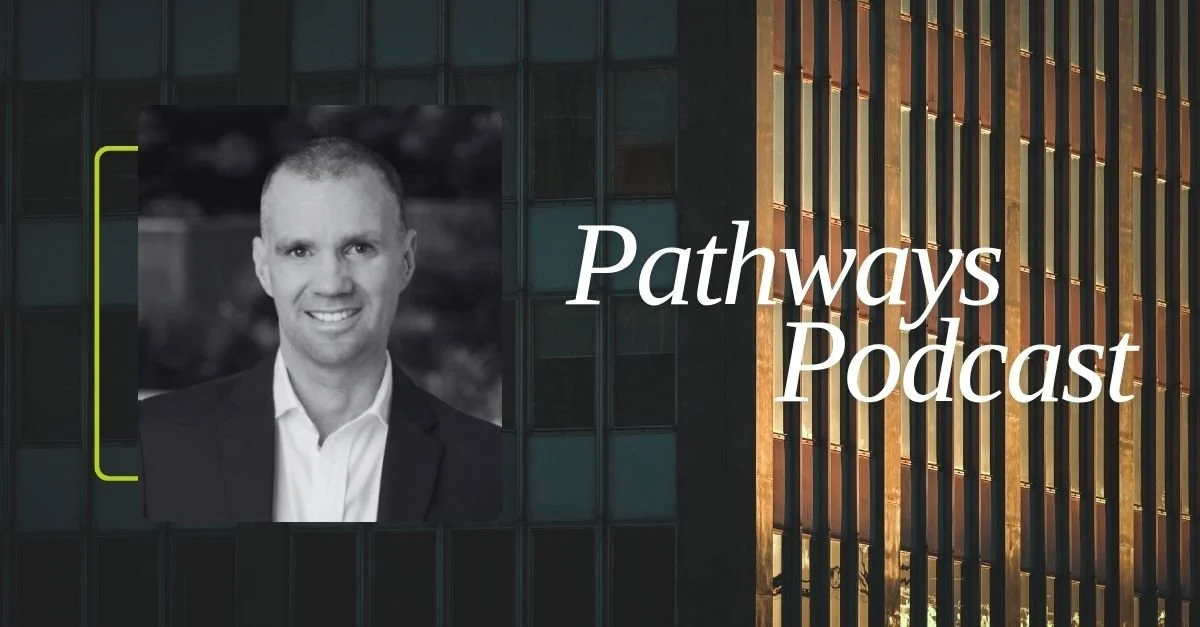
Pathways — Glenn Johnson, Zero Latency
Summary
Glenn Johnson’s career has been anything but linear, starting at GM Holden before moving through a mix of large corporates and transformation-heavy roles across Tabcorp, Sensis and Service Stream.
Exposure to major projects — from digital disruption at Sensis to leading large-scale ERP transformation programs — built a capability for stepping into complexity and delivering change at scale.
A consistent theme throughout his journey is versatility, taking on dual roles and expanding beyond traditional finance to drive broader business outcomes and strategic initiatives.
Now operating in the fast-moving world of virtual reality at Zero Latency, he brings a growth-focused mindset — balancing rapid global expansion with the discipline required to build a sustainable, scalable business model.
A wild career ride
Once you find out CFO of Zero Latency, Glenn Johnson began his career at GM Holden, you know you’re going to be in for a wild ride. Glenn’s resume boasts a timeline of mega companies including Tabcorp, Service Steam, Sensis — and now, Zero Latency, one of the world’s finest virtual reality experiences, renowned for its multiplayer, free-roam VR experience in a warehouse-scale arena. See, wild ride.
Glenn sat down with Liam Killen, Director of Atlas Partners to chat about the journey, new adventures, and finding time for passions.
Episode transcript
Liam: I’m joined today by Glenn Johnson, CFO of Zero Latency. Glenn, thanks so much for joining us.
Glenn: Thanks, Liam. Great to be here.
Liam: Glenn, let’s start from the beginning. Can you walk us through your career to date, starting with your early roles?
Glenn: Sure. After graduating from the University of Melbourne with a Bachelor of Commerce, I started my career at Southcorp, which later merged into Pacific Dunlop. It was a great foundation, and after four or five years, I moved to Holden, where I stepped into a treasury role.
That gave me strong exposure to foreign exchange, managing currency flows and hedging. From there, I moved into management reporting, overseeing consolidated results for the executive team and board. It was a great time to be at Holden — it was the number one car brand in Australia.
After a few years, I was keen to gain experience in an ASX-listed environment, which led me to Tabcorp.
Liam: And what did that move to Tabcorp involve?
Glenn: I joined in a group reporting role, again working closely with the executive team, board and external stakeholders during reporting periods. Toward the end of my time there, I moved into a financial controller role for the casino division in Queensland.
That was a really valuable shift — moving out of a corporate role and into a more operational environment, working directly with business leaders. It gave me a much stronger foundation in business partnering early in my career.
Liam: You then spent a significant amount of time at Service Stream across two stints. What drew you there initially?
Glenn: At that point, I felt like I had strong experience in management reporting and business partnering, but I was missing exposure to external reporting and audit. Service Stream gave me that opportunity.
I joined as Group Financial Controller, later moving into a GM Finance role. I was able to get hands-on with audit processes, work closely with the Audit and Risk Committee, and oversee market reporting. I also led a large shared services team, covering accounts payable, receivable and payroll.
It was a really well-rounded ASX-listed finance role.
Liam: You left and then returned to Service Stream — what drove that decision?
Glenn: After a few years, I was keen to try something new, which led me to Sensis. It had just been spun out of Telstra and was backed by private equity, so it felt like an exciting opportunity.
In hindsight, it probably wasn’t the right move. The business was going through a challenging transition from print to digital and competing with major players like Google. But it was a good learning experience.
I stayed connected with people at Service Stream, and about a year later, I returned in a Business Unit CFO role, leading the network construction division.
Liam: And that role evolved quite a bit, didn’t it?
Glenn: It did. Alongside the Business Unit CFO role, I was asked to lead a major ERP transformation across the group. So I was effectively wearing two hats — running a division and overseeing a large-scale systems implementation.
Eventually, I moved full-time onto the ERP project for the final couple of years. It was a fantastic opportunity to build a completely new skill set and lead change at a group-wide level.
Liam: Your first CFO role came next at Bread Solutions — what was that experience like?
Glenn: It was both challenging and rewarding. I joined right at the start of COVID, which created immediate operational challenges. We were supplying major supermarkets like Coles and Woolworths, and demand was high, but managing workforce disruptions and supply constraints was difficult.
At the same time, I was involved in negotiating a new manufacturing facility and restructuring the company’s debt. I also took on responsibility for the commercial side of the business, managing key customer relationships.
It was a steep learning curve but a great experience in broadening beyond finance.
Liam: And now at Zero Latency — tell us about the business and your role there.
Glenn: Zero Latency is a really exciting business in the location-based entertainment space. We’ve grown from a single venue in Melbourne to over 100 globally, and we’re backed by private equity.
The focus now is on scaling the business sustainably — expanding to 250–300 venues while ensuring existing locations are successful. A big part of that is continuing to invest in game development to keep customers engaged.
It’s a fast-moving, growth-oriented environment, which I really enjoy.
Liam: You’ve had exposure to private equity — what stands out about that environment?
Glenn: The core finance disciplines are the same, but private equity brings a strong focus on growth and value creation. Decision-making tends to be faster, and there’s a clear alignment around outcomes and eventual exit.
It’s a very dynamic environment, which suits people who enjoy pace and being close to both operations and strategy.
Liam: Outside of work, you’ve got a strong interest in sport and fitness. Tell us a bit about that.
Glenn: I’ve always been into sport. I completed a personal training qualification a few years ago — something I may still pursue down the track.
I’ve also recently started umpiring football, which has been great. It keeps me active and gives me a good balance outside of work.
Liam: Looking back, was there a “sliding doors” moment in your career?
Glenn: Moving to Sensis was probably one. I was quite ambitious at the time and maybe didn’t fully think through the decision. It didn’t work out as planned, but it was a valuable learning experience.
Liam: And finally, what’s the best advice you’ve received?
Glenn: One of the biggest things I took from my time at Tabcorp was the importance of quality and attention to detail. When you’re producing work for senior stakeholders or the market, accuracy and presentation really matter.
Taking the time to get things right builds trust and credibility — and that’s something I’ve carried with me throughout my career.
Liam: Glenn Johnson, thanks so much for joining us.
Glenn: Thanks, Liam.