
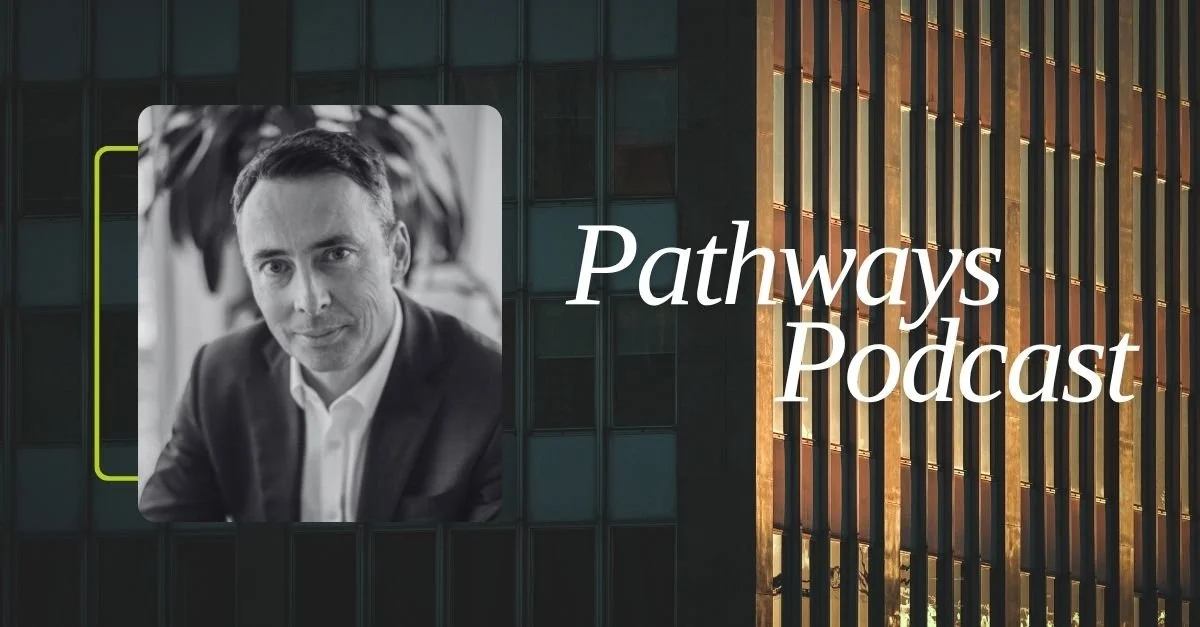
Pathways — Carl Walsh, ANZ Worldline
Summary
Carl Walsh’s career has been driven by curiosity and a global mindset, growing up on the west coast of Ireland before using his career as a vehicle to explore international opportunities across finance and technology.
Starting in professional services at Deloitte, he built a strong technical foundation before moving into industry, where he developed a broader commercial lens across large, complex organisations.
A defining theme throughout his journey is the importance of leadership and environment — recognising that who you work for, and the clarity they provide, has a significant impact on both performance and long-term career satisfaction.
Now at ANZ Worldline, he operates at the intersection of banking and payments technology, navigating the complexity of a joint venture while focusing on growth, platform transformation and delivering differentiated solutions in a rapidly evolving market.
A global career mindset
Carl Walsh hasn’t just built a fascinating career, he has lived a fascinating life. As a young man growing up on rugged West Clare coastline in Ireland, he saw the world as his oyster and his career as his ticket.
The journey has taken Carl to some of the biggest financial and technology companies in the world, leading him to Melbourne and the role of CFO for ANZ Worldline, a joint venture between ANZ and Worldline.
Carl has learned lessons and gained incredible wisdom along the way, which he shared with Liam Killen, for this episode of Pathways.
Episode transcript
Liam: Today I’m joined by Carl Walsh, CFO of ANZ Worldline. Carl, thanks so much for joining me.
Carl: You’re welcome, Liam. I’m very happy to be here.
Liam: Let’s start at the beginning. You’re a proud Irishman — can you take us back to your early life and how your career began?
Carl: Sure. I grew up in Milltown Malbay in County Clare, on the west coast of Ireland. It’s a beautiful part of the world — very community-driven. A lot of my early years were spent playing Gaelic football and being involved in the GAA, which was a big part of life and still is for me today.
From a career perspective, I studied law at university, having come from a science and maths background. I actually considered joining the army like my father, but he encouraged me to pursue something else. That’s what led me to Deloitte.
I joined their Limerick office as what they called a “non-relevant graduate,” which meant I didn’t come from a business background. It turned out to be a great start — it was a small office, so we did everything: audit, tax, accounting, insolvency. That variety helped me understand what I enjoyed and what I didn’t, and I realised fairly early that I wanted to move into industry.
Liam: You then made a pretty unconventional move early in your career — heading to Russia. What led to that?
Carl: At the time, Ireland was in a recession with limited opportunities. I had a strong desire to travel, and Eastern Europe was opening up after the fall of the Iron Curtain.
I ended up in Moscow working for a joint venture in the IT sector, supplying hardware and software to banks and multinational companies entering the Russian market. I was one of only two expats in a team of about 50.
It was an incredible experience — I learned the language, immersed myself in the culture, and developed a much broader perspective. But it was also challenging. The ruble devaluation in the mid-90s had a significant impact on the business, and I learned a lot about cash flow, risk and operating in volatile environments.
Liam: After that, you returned to Ireland and eventually joined GE. What was that experience like?
Carl: GE was a pivotal part of my career. I joined their Consumer Finance division in Europe, which was growing rapidly through acquisitions. My role involved working across different countries, managing budgets, forecasts and reporting.
One of my mentors there, Paul Whelan, encouraged me to move into a more operational role, which led me to Australia. At the time, it was meant to be a short-term move — maybe two years — but we ended up staying.
I spent over a decade with GE, and it was a fantastic environment to learn in. It really shaped how I think about leadership, performance and culture.
Liam: And Australia ended up becoming home?
Carl: It did. We settled in Melbourne, built a life here, and now more than 20 years later, we’re still here. It wasn’t part of the original plan, but it’s worked out incredibly well.
Liam: Post-GE, you moved across a number of different industries. What did that part of your career look like?
Carl: I’ve worked across banking, telecommunications, manufacturing and now payments. Each role has been different, and I’ve learned a lot along the way.
One of the key lessons for me has been the importance of culture and leadership. GE was a great fit for me, and not every organisation after that has been the same. It really reinforced how important it is to find an environment where you can thrive and align with the leadership style.
Liam: Let’s talk about your current role at ANZ Worldline. How would you describe the business?
Carl: It’s a really interesting setup. We’re a joint venture between ANZ and Worldline, which is a major European payments company.
The focus is on building a leading payments platform in Australia — migrating customers onto new technology, launching new products, and creating a more competitive offering in the market.
The joint venture structure adds complexity. Worldline owns 51% and ANZ 49%, so you’ve got two shareholders with slightly different priorities. Managing that dynamic is a key part of the role — ensuring alignment while delivering value for customers and the business.
The industry itself is incredibly competitive and evolving quickly, with strong players like Stripe, Block and Adyen. It’s a fast-moving space, which makes it exciting.
Liam: You mentioned leadership earlier — how important is that in your current role?
Carl: It’s critical. I’m probably at the happiest point in my career right now, and a big part of that is the leadership environment.
I’ve got a new CEO who is very clear, very direct and highly customer-focused. That clarity makes a huge difference. Knowing what’s expected of you — even at this stage in your career — is incredibly valuable.
Who you work for matters a lot more than people sometimes realise.
Liam: We can’t talk about you without touching on sport, particularly GAA. What role has that played in your life?
Carl: A huge one. I’ve been involved in Gaelic football since I was a kid, playing at club, county and provincial levels. Some of my best memories come from that time.
Since moving to Australia, I’ve stayed heavily involved. I’m currently president of Young Melbourne GAA, which has grown significantly over the years. We now have over 200 kids involved, as well as men’s and women’s teams.
For me, it’s about giving back and creating an environment where people can enjoy sport, build friendships and develop.
Liam: Do you see a connection between sport and business?
Carl: To a degree. I think it’s sometimes overstated, but sport does help develop qualities like teamwork, resilience and discipline.
One key difference is that sport is voluntary — people choose to be there. In the workplace, there are different dynamics at play. But the behaviours you develop through sport can certainly carry across and make you a better colleague or leader.
Liam: Looking back, have there been any “sliding doors” moments in your career?
Carl: Definitely. Meeting Paul Whelan at GE was a big one — he had a significant influence on my development.
More recently, my current CEO has had a similar impact. On the flip side, there have been roles I probably shouldn’t have taken. Often those decisions came from rushing or ignoring my gut instinct.
That’s something I’ve learned over time — trust your intuition. If something doesn’t feel right, it usually isn’t.
Liam: And finally, what’s the best advice you’ve ever received?
Carl: Something my father told me has always stuck with me — never sell your soul to any organisation.
It’s really about maintaining balance and making sure you’re doing the right thing for yourself and your family. Work is important, but it shouldn’t come at the expense of everything else.
If you stay true to that, you’re more likely to make better decisions and have a more sustainable career.
Liam: Carl Walsh, thanks so much for joining me.
Carl: Thanks, Liam. Appreciate it.