
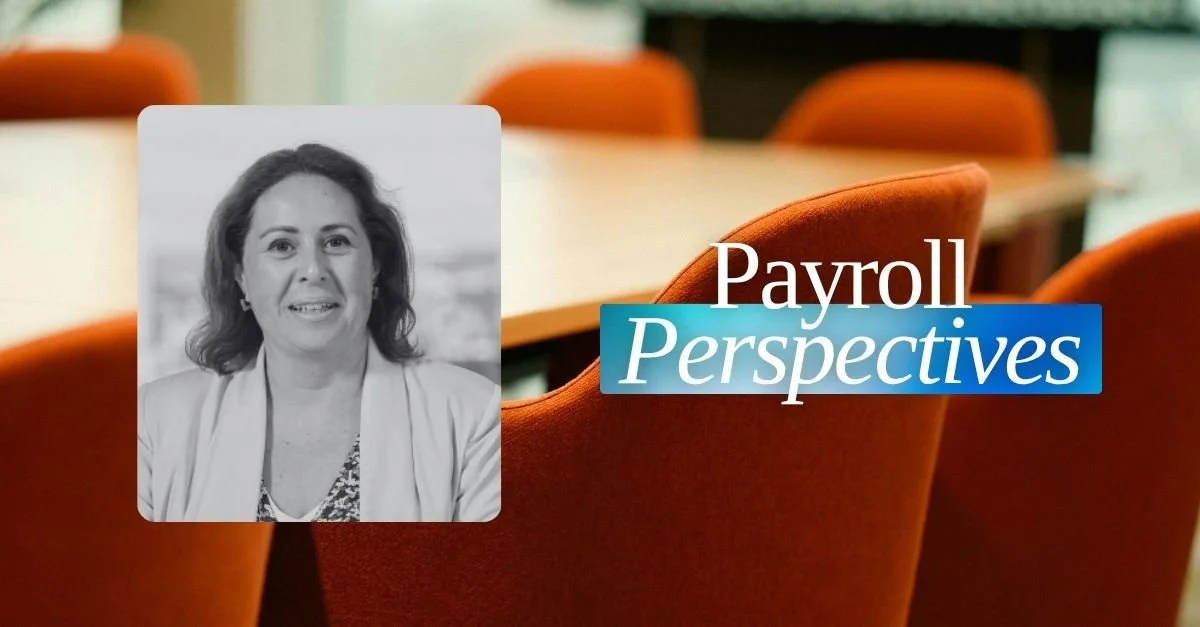
Payroll Perspectives - Tania Fenech, Hall & Wilcox
Summary
Tania Fenech’s career has been shaped by over 25 years in payroll, building deep expertise across multiple industries and progressing into her role as Payroll Manager at Hall & Wilcox.
A defining theme throughout her journey is the complexity of payroll — challenging the misconception that it is a simple, automated function and highlighting the layered nature of compliance, awards and industry-specific requirements.
Her experience, particularly in high-pressure environments like aged care during COVID, reflects the importance of resilience, adaptability and maintaining accuracy in roles where timing and precision are critical.
She also emphasises a key reality of the profession — that payroll is often a behind-the-scenes function, where recognition is limited, and success relies on consistency, accountability and a strong internal support network.
The reality of payroll
Tania Fenech didn’t choose a career in payroll — it chose her — straight out of school, while she was working part time for Coles. Twenty-five years later, she has built a phenomenal career honing her craft across various industries, leading to become the Payroll Manager at Hall and Wilcox.
Tania met with Shawny Smith of Atlas Partners for our Payroll Perspectives podcast.
Episode transcript
Shawny: Hi, Tania. Thank you so much for joining me for an episode of the Payroll Perspective podcast.
Tania: No problem. Thanks for having me.
Shawny: We usually just start off with a brief introduction — yourself, your career, and how you got into payroll.
Tania: I guess I’ll be saying what most people say who work in payroll — I didn’t choose payroll, payroll chose me. I was working part-time while at uni for Coles, and an opportunity came up to learn payroll in the office. I thought I’d give it a go while studying, and over 25 years later, I’m still in payroll.
I stayed in retail for quite a long time, then moved into food manufacturing, hospitality, aged care, and now I’m Payroll Manager in professional services at a law firm, Hall & Wilcox. I’ve been fortunate to work across many industries, so there’s been a lot of learning along the way.
Shawny: You’ve worked across a lot of industries — have you found any more complex than others?
Tania: Payroll in general is complex, even though people think it’s just pushing a button. But some industries definitely add another layer. Aged care was probably the most complex — it’s not a Monday to Friday operation. You’ve got 24/7 shifts, overnight work, active and inactive shifts — it’s very complicated.
On top of that, there’s a staff shortage. I was working in aged care during the pandemic, and the burnout was huge. Employees were doing extra shifts, so if there were pay errors, frustration was understandably high. It was a really difficult environment for everyone.
Shawny: That’s something I hear a lot — complexity and turnover in aged care.
Tania: Exactly. High turnover due to burnout made it even more challenging. There were always shifts needing coverage, so it was tough across the board.
Shawny: I’ve heard retail has its own challenges too, but maybe not the same level of complexity.
Tania: That’s right.
Shawny: What about systems — is there one that stands out as particularly good?
Tania: Technology has come a long way over the last 20 years. At my previous role, I was involved in implementing Employment Hero, including both HR and payroll modules. That full integration was a game changer.
Before that, everything was manual — spreadsheets, manual processes. With Employment Hero, we reduced manual touchpoints and the risk of human error. The employee experience improved too, especially with the self-service portal — employees could submit leave and timesheets via the app instead of paper forms.
Support was also excellent — Australia-based, responsive, and quick to resolve issues. Compared to older systems, it was a really positive experience.
Shawny: Self-service really does reduce admin and errors across the business.
Tania: Absolutely. Payroll teams are always time-poor, so any time saved is critical. There’s always more to do — audits, compliance checks — so removing manual tasks is essential.
Shawny: What’s been the biggest challenge in the last few years?
Tania: COVID was a major one. We didn’t have work-from-home setups, so we had to quickly pivot and figure out new ways of working. That was a big adjustment.
Beyond that, it’s the constant legislative change — STP updates, wage theft laws. It feels like there’s something new every week. You have to stay on top of it or risk falling behind and creating compliance issues.
You need to make time for learning and development, even when you’re busy managing day-to-day work.
Shawny: The pace of change has definitely increased.
Tania: It really has.
Shawny: What are the top three skills that make a great payroll officer?
Tania: First — attitude. Even without experience, if someone is willing to learn, that’s a huge advantage. Second — attention to detail. Small errors can have big consequences. And third — organisation.
Payroll is fast-paced — you’re juggling multiple tasks, interruptions, and deadlines. If you’re not organised, things get missed, and that creates bigger issues down the line.
Shawny: Burnout has been a big topic — what are your thoughts?
Tania: There’s still a lack of understanding about how complex payroll is. People think it’s just pressing a button, but there’s a huge amount of work behind the scenes.
You only hear about payroll when something goes wrong — it’s a thankless job in that sense. While there’s more awareness now, especially with compliance issues being in the spotlight, there’s still a long way to go.
Shawny: What’s the best advice you’ve received in your career?
Tania: Build resilience and don’t give up when things get challenging. Payroll isn’t an easy job — it’s not a strict nine-to-five role. There are times when you need to stay back and resolve issues because people rely on being paid correctly.
Some people leave the industry because of the pressure, but if you persevere and surround yourself with the right people, it can be very rewarding.
Shawny: It’s definitely rewarding, but hard work.
Tania: What I enjoy is working with a wide range of people. You’re not just behind a computer — you’re interacting with everyone from executives to frontline workers. You meet people from all walks of life, and that keeps it interesting.
Shawny: You really do speak to everyone in the business.
Tania: That’s right — we’re the most important people to them.
Shawny: That’s a great note to end on. Thanks so much for your time, Tania.
Tania: No problem. Good to talk to you.