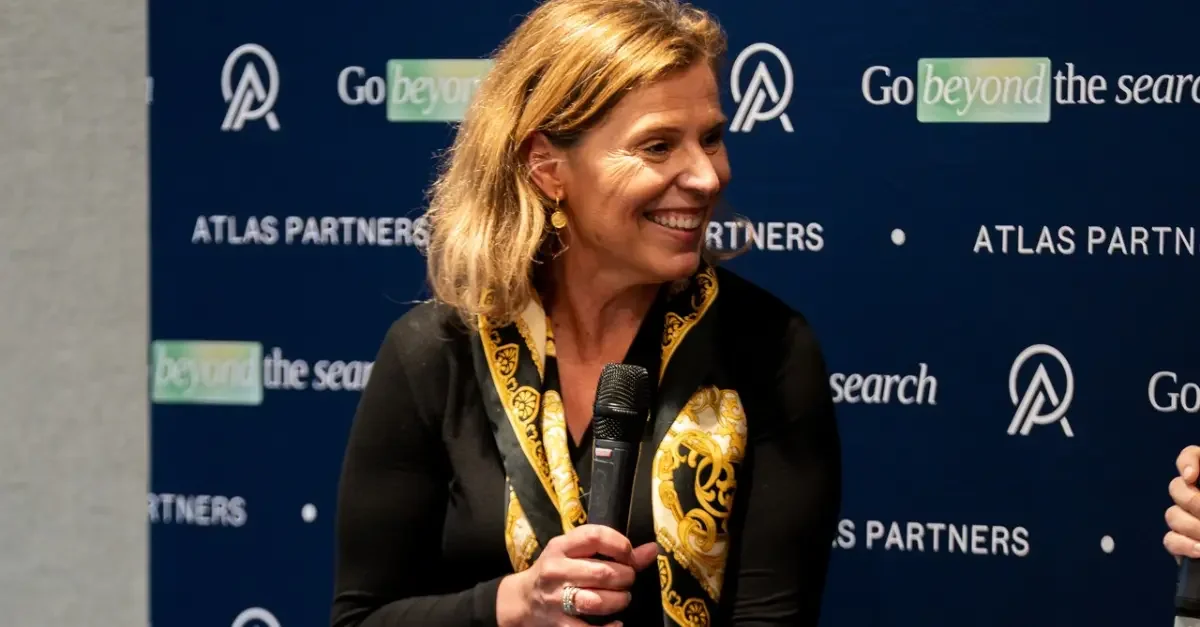
Nicole Randle, CFO of Richmond Football Club presenting at NextGen Power Moves
For decades, the career ladder has shaped how we think about professional success. You start at the bottom, work your way up and measure progress by the promotions you collect along the way.
But careers rarely unfold quite so neatly.
The idea of a career lattice challenges the traditional upward climb, recognising that moving sideways, exploring different functions and gaining experience across industries can be just as valuable as taking the next step up.
It's an approach reflected in the career of Nicole Randle, CFO of Richmond Football Club, whose journey has taken her through banking, technology, governance, wine and professional sport.
At a recent Atlas Partners NextGen Power Moves breakfast, Nicole joined Melissa Azzopardi, GM Finance at the AFL, to explore how she's navigated those moves, the capabilities she's built along the way and why taking ownership of your career matters more than following a predetermined path.
You've built a career across several industries and functions. How much of that journey was intentional?
One of the best pieces of advice I was given early on was that when it comes to your career, you're the only one who will drive it. No one else will do it for you. If you just wait to get tapped on the shoulder, you run the risk of being a little bit rudderless.
The second piece of advice was to never think a career plan can only be linear. Always think about multiple options.
Ultimately, I always wanted to be a CFO, but I knew that aiming only for CFO was too narrow. So I always had a COO path in there as well, alongside the traditional finance path.
Key insight: Alongside that, keep your career plan a live document. It's not set-and-forget, sitting in the bottom drawer. It's something you keep alive.
When we're encouraged to keep climbing, how do we recognise the value of a sideways move?
A lot of my career has been sideways moves. I quickly realised it's not always about the upward move or the promotion. Sometimes you get more from a lateral move.
I was CFO for Technology at the bank, a big, complicated gig. I got to a point where I thought, "I've done this. I've got it to where it needs to be. I want to do something different."
I was talking to the Deputy CFO at the time, and he said, "We've got a role as Global Head of Governance for Finance." My first reaction was, "Governance? Really? I don't really want to do that."
I spent a lot of time thinking about it. The first question I asked was why they'd come to me. What did they see? Move away from the title. What really is this role?
It ended up being the best sideways move I've ever made.
Rather than being deep in one part of the business, I got a bird's-eye view across the whole organisation globally. I got exposure to the board and the most senior executives in the bank. And I was responsible for creating a governance framework that didn't exist, and bringing 25,000 people on the journey.
I'd never have had that opportunity in any role I'd done before.
That taught me sideways moves aren't about being shunted. I used to use the concept of Snakes and Ladders with my teams. You get from start to finish, but it's never only up.
Key insight: Pick the sideways moves that matter to you. They'll give you a richer experience to carve your own way.
Transcript: Read the full conversation between Nicole & Melissa
How can finance professionals deliberately build experience beyond their technical expertise?
Early in my career, I was introduced to what I call "the wheel". It's about recognising the experiences and capabilities you need to build to be more than just a finance professional.
The wheel is about the skills beyond your technical finance skills: exposure to systems, risk, legal, transformation and sales. Think about where you'd plot yourself today, where the gaps are and how you'll start to address them.
If you're ever asked to get involved in a project, say yes. Then back it up with, "And I want to be more than just the finance person."
Anyone in finance, while you've got that deep expertise, usually knows more about the business than a lot of the business leaders do, because you understand the drivers and all the other components.
Second, make it known what you want exposure to. A while ago I was being asked to look at contracts, and I thought, "I really need some help here." So I sought out someone in our legal team and asked if we could spend some time together. I wanted to understand how to think about a contract and what to look out for.
In a way, you're building networks to build a skill. And whenever you go to someone in a business and ask for help, nine times out of ten the answer is "sure", because people want to help each other.
Be deliberate. Know the skills you want to keep building, whether that's sales or transformation, and reach out to those areas. Find ways to get exposure and build relationships in the areas you want to grow in.
Key insight: It's on you to be specific about the skill you're looking for and how your organisation can help you get it.
Does building a less conventional career require greater confidence in your own abilities?
From what I've seen interviewing over the years, there's a gender difference. Men will often tick through the ten boxes and say, "I've got this." Women will usually want to be sure they've got eight out of ten nailed.
For finance people, I'd start by saying this, and not in a negative way: finance is, technically, a commodity.
Think about what drives revenue. Price times volume equals revenue, in its simplest form. Moving from banking to the wine industry to football, those same principles held true.
So first and foremost, finance is transferable across any industry and any country. Know that and back yourself. It's also about recognising the experience you already have.
My nephew was applying for graduate roles and asked me to look at his CV. He'd spent the last couple of years at Hungry Jack's, going from cashier to manager, and that's all his CV said.
I said, "Mate, let's reframe that. What are you actually doing at Hungry Jack's? You're doing stock control and quality control. You're performance managing. You're doing customer service and upholding quality standards. There's so much you're doing that isn't on that piece of paper. You're underselling yourself."
From the CVs I've seen, women tend to be less comfortable with the selling side.
So when you put yourself forward, put your chest out a little and ask: what have I actually done, and what does it really look like?
Key insight: Be thoughtful about how you position yourself, while still being authentic to who you are.
Listen: Melissa Azzopardi on Pathways Podcast
Ultimately, how does that breadth of experience shape a better finance leader?
Everyone in this room is a deep finance expert. That's your bread and butter and your superpower. But the X factor is: what else do you bring?
You lean into conversations on risk, economic factors and strategy. It's preparing the key questions. What should we be talking about as a business?
Be curious, inquisitive and proactive, and think beyond the problem in front of you to what else needs considering. Sometimes you won't know the answer. Even just asking the group, "Is there anything else we should be considering?" can create an unlock moment.
Whenever I meet with the business, I avoid accounting language and put things in language they know.
In football, for instance, one of the big revenue streams is sponsorship. I could talk about pricing strategy, but what matters most? The renewal rate. The longevity of the partnership. How do we partner with sponsors for more than a three-year period?
At the end of the day it's revenue. But rather than starting with "What's your revenue target?", I pick up the language they use, so we're immediately aligned.
You indirectly gain a lot more knowledge of the business. You deepen your understanding of the revenue drivers and the levers being pulled.
Never underestimate that in finance you don't only see the financials. Finance is at the start of the game and at the end of the game. You see the trends.
Key insight: Be curious about what's driving the results, not just the numbers.
And for anyone thinking about their next career move, I'd leave them with three things: only you can back yourself, find someone you trust who you can share where you're heading with, and have a career plan.
Your line manager or company has probably asked you for a career plan or development plan. Do it, and really take the driver's seat.