Summary
Di Hill reflects on a career spanning around 20 years in payroll, including eight years with Frontier Software, vendor project management, systems leadership and direct involvement in enterprise agreement bargaining. Her path into the profession eventually brought her back to the interests that first inspired her to study HR and payroll.
The conversation explores the complexity of interpreting enterprise agreements, public holiday entitlements and long service leave, particularly in 24/7 healthcare environments where the people recording payroll information are primarily focused on delivering care.
Di identifies missing process documentation, manual workarounds, integration issues and gaps in historical employee data as recurring payroll challenges. She also explains why the people who will use a new system need to be involved in choosing, configuring and testing it.
Shawny and Di consider practical uses of AI, increasing salary pressures and retention challenges, and the importance of integrity in building a career. For Di, payroll offers the opportunity to solve complex problems while making a tangible difference to employees.
Understanding the systems behind accurate pay
Di Hill's path into payroll began with an interest in enterprise bargaining. After returning to university to pursue that interest, her career initially took her through project management and software before she found her way into payroll, where she has now spent around 20 years.
That experience has given Di an understanding of the relationship between enterprise agreements, payroll systems and the people responsible for getting employees paid correctly. From interpreting complex conditions to helping organisations improve the way information moves between systems, much of her work has involved understanding how payroll processes operate in practice and where they can be improved.
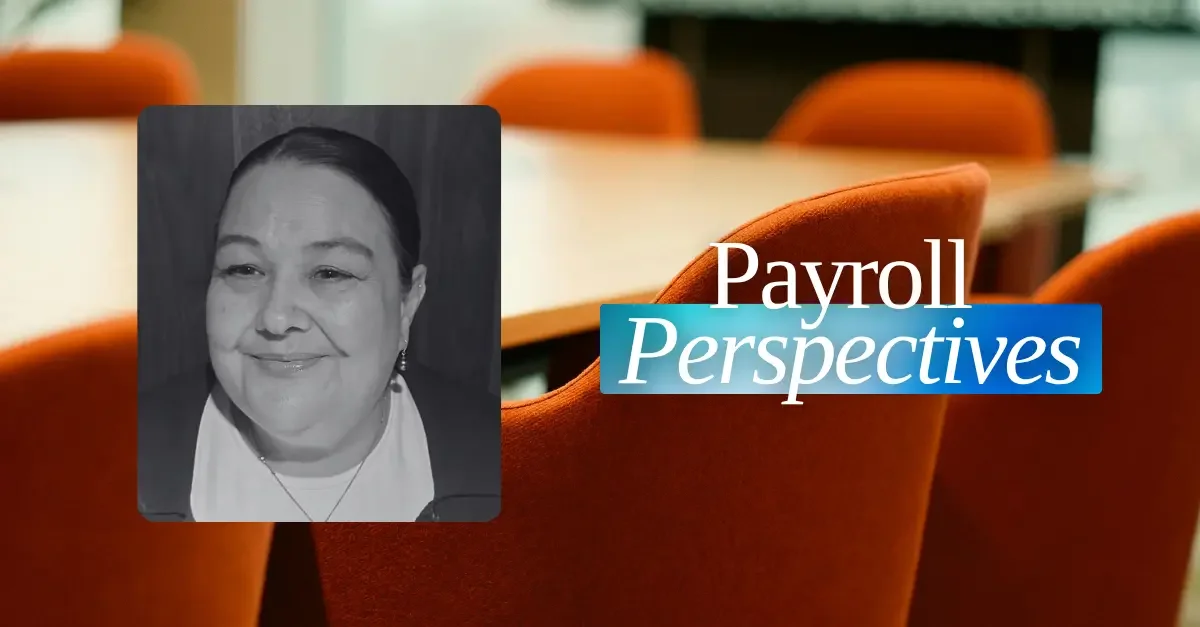
In Season 2, Episode 5 of Payroll Perspectives, Di joins Shawny Smith to discuss the challenges of healthcare payroll, the importance of documentation and data quality, and why system implementations need genuine input from the people who will use them. They also explore the opportunities and limitations of AI, the pressures shaping payroll salaries and the career experiences that have stayed with Di.
Episode transcript
Finding a way into payroll
Shawny: Hi Di, thanks for joining me for Season 2, Episode 5 of Payroll Perspectives. I'm Shawny Smith from Atlas Partners, and we've known each other for quite a long time, so I really appreciate you joining me. We usually start with an introduction. Can you tell us a little about yourself and your career so far?
Di: I was involved in enterprise bargaining as a member of a bargaining team, and that really inspired me to get involved in payroll and HR. I quit my job, went to university and got a degree, but I couldn't get a job in that field afterwards. I fell into project management instead. I worked as a vendor project manager, in fixed assets, and then in healthcare and community care for a Canadian company. Eventually, I made my way into payroll, and I've been in the field for around 20 years.
Shawny: How did you make that first step from project management into payroll?
Di: I became a vendor project manager for a payroll software company. I worked for Frontier Software for about eight years.
Shawny: It was a bit of a pivot, but one you obviously enjoyed and have stuck with. It's interesting how you went to university with one career in mind and eventually came full circle.
Di: Absolutely. In my previous role, I was part of the bargaining team for four enterprise agreements in a row. It was fascinating and really rewarding. I've only been in my current role for about a year.
Shawny: I've known you through some of that time, and you've carved out a niche as a payroll systems specialist, with enterprise agreements and bargaining as part of your experience. How did that evolve from your time at Frontier?
Di: While I was at Frontier, I received a call from a customer I'd worked with on a reimplementation the previous year. They had an opportunity for a systems team leader or manager and asked if I was interested. I felt ready for something new. During my time at Frontier, I'd got married and had a baby, so life had changed quite significantly. The new role was also a five-minute walk from home, which made it a very attractive move.
Shawny: Have most of your payroll opportunities come through people approaching you, or have you applied directly?
Di: I've actually been very steady in my career and haven't changed roles a lot. The next move happened in a similar way: someone called me about a role and asked whether I'd be interested.
Shawny: You've spent long periods with your employers, so timing seems to have played an important part in your career decisions.
Di: It has. By that next move, my daughter was going into Year 12, and I was a single parent with a lot of responsibility. My previous role was very demanding, so I was looking for a change. I do feel very lucky with how things have worked out.
Making sense of complex enterprise agreements
Shawny: You describe yourself as a payroll systems leader. What does that actually involve for you?
Di: I love problem-solving, and payroll in Australia is so complex. People underestimate just how complex it is. One of my strengths is reading an enterprise agreement and understanding what it means. You can have three people read the same sentence in an agreement and come away with three different interpretations, particularly around allowances and other conditions. I think better systems can produce better outcomes for employees, and that means configuring the systems to match the enterprise agreements.
Shawny: It's also about establishing a shared understanding of what those agreements mean. Different people can interpret the same clause differently, so there needs to be collaboration with specialists, consideration of relevant Fair Work decisions and a clear interpretation before anything is built into the system. Otherwise, you can end up doing a lot of remediation later. You also have employees questioning their payslips, and you need to be able to explain why a particular interpretation has been applied.
Di: We get a lot of questions about public holidays. They're particularly difficult for employees who work around the clock on rotating rosters. People want to know when they're entitled to particular payments and why, and explaining exactly how those rules work can be tough.
Shawny: Is that one of the most challenging things to explain?
Di: The other big one for me is long service leave.
Shawny: It's another area with a lot of complexity in Australia, alongside the number of enterprise agreements and awards and the different ways conditions can be interpreted. Long service leave rules have also changed over time.
Di: Where I work now, we complete a reconciliation every time somebody takes long service leave. I don't believe there's a system that can do everything we need it to do.
Shawny: That's where specialist knowledge and manual review are still so important. You can't always rely on a system to produce the right number without checking it. It leads into another conversation we're all having about AI. As useful as it can be in reducing administrative work, we still need people to review the information and make judgements about whether it is accurate.
Using AI without losing judgement
Shawny: Some people are worried about what AI might mean for their jobs, but many of the payroll professionals I speak to have become busier while learning how to use it. It can handle parts of the administration, but it still needs oversight. How have you been using AI?
Di: I've barely dipped my toe in the water, but I love it. It helps me write emails and adjust the tone to give them the warmth I'm looking for. I've also given it some rules. I want it to justify its responses, not give me information that isn't true, and show me where the information comes from. Even so, you have to be really careful.
Shawny: Absolutely. You have to work out where AI is worthwhile and where checking and reworking the output takes just as long as doing it yourself. Sometimes it gives you information that's simply not accurate. I tried asking one AI platform for interesting historical payroll facts and got a story that sounded great. When I put it into another platform, it challenged the accuracy of the story. So you need to remain sceptical. But it can be very useful when you're trying to make an email more professional, soften the tone or tailor it to the audience, as long as you edit the final version yourself.
Di: I also use it for Excel IF statements. I've got a 20-step IF statement in one of my pay-rate checks that AI helped sort out because I couldn't get it to work. It's been really useful for that.
Shawny: That's a great example. Advanced Excel skills are important in specialised payroll and accounting roles, but AI can help people work out which formulas will produce the result they need. Even someone with extensive Excel experience might discover an approach they hadn't considered, while someone with less experience can produce more sophisticated work with the right checks.
The particular challenges of healthcare payroll
Shawny: Coming back to enterprise agreements, you've worked with software providers, not-for-profits and health organisations. What makes healthcare payroll particularly challenging?
Di: I think it's the 24/7 environment. Healthcare services are always operating. The people handling payroll tasks at a site level are focused on healthcare. That's what they're there to do, and payroll administration isn't their priority. It shouldn't have to be. We need to make the system as easy as possible for them, and that's the best outcome for everybody.
Shawny: That makes sense. When I recruited in healthcare, I found that doctors and other employees often had established ways of submitting timesheets, hours and expenses. In a fast-moving environment, those routines are things people rely on. Introducing new systems or processes can be challenging, and significant change can be slow.
Di: There's also a lot of turnover in healthcare. You might have someone who's been trained in a particular way training the next person, and that becomes the only process they know. There are definitely challenges around training as well.
The gaps that follow organisations from system to system
Shawny: When you enter a new payroll environment, what inefficiencies do you tend to find first? What are you looking at in the systems and processes?
Di: The biggest thing is non-existent process documentation. Someone might say, 'I've been doing it for ten years, and I've got a piece of paper with some notes. That's how we do it.' But what happens when that person isn't there? How does somebody else learn the process?
Another big issue is manual workarounds. Why are we doing something manually? What's wrong with the system, and how can we fix it so that workaround isn't necessary?
Integration is another one. Data comes in from other systems and may not be correct, might go into the wrong place or might contain errors because the source system uses the wrong code.
And then there's historical source data. You might have an employee who's been with the organisation for 30 years but has been through three different payroll systems. You don't necessarily have all the historical data you need to calculate certain entitlements accurately, particularly long service leave and average hours. Sometimes that history is impossible to reconstruct. You have to make assumptions and get agreement on how those assumptions will be applied. Those are the biggest issues for me.
Shawny: The documentation point is particularly striking. Organisations have gone through enormous transformation over the last few years, including shifts to remote working and digital processes. Yet some payroll functions still rely heavily on an individual's notes and knowledge. That only works while that person is available, and it makes compliance oversight difficult.
Di: Payroll is always moving. You're preparing the next pay run, managing adjustments from the last one and dealing with everything else that comes in. There doesn't seem to be much headspace. You might undertake a big project to update the documentation, but then it lapses. A process changes, a new template is introduced, and no one goes back to update the documents.
Shawny: It's one reason we're seeing more organisations establish dedicated systems and compliance positions. In the past, those functions were often limited to very large payroll teams. Now other businesses are recognising the need for people to focus specifically on documentation, changes to enterprise agreements, system issues and implementation work.
Di: The pace of change is part of it too. Single Touch Payroll, for example, meant rewriting processes, and new requirements keep coming through. You have to understand the changes, work out the process and document it. It all takes time.
Salary pressure, retention and the value of expertise
Shawny: When I'm speaking with finance or HR leaders, particularly in smaller organisations, they sometimes ask why payroll salaries have increased so much. The amount of change and responsibility in the profession over the last five to ten years has been extraordinary. We've had changes in reporting, new compliance expectations and ongoing concerns about burnout. The responsibility and risk attached to payroll roles have increased, but that isn't always well understood by people outside the function.
Di: We're experiencing that at my organisation. We've recently had someone leave for a $25,000 pay rise.
Shawny: And it's hard to criticise someone for accepting such a significant increase.
Di: Exactly. It also increases the risk of other people doing the same thing, which can leave the team very short-staffed.
Shawny: Organisations can then find themselves needing to increase salaries to retain or replace people, even though reviewing pay earlier might have helped prevent the situation. I know these decisions aren't always simple, but the consequences of not addressing market salaries can be significant.
Di: We've also had two excellent candidates turn down offers because the salary wasn't enough.
Shawny: That makes recruitment difficult. There can still be large differences between what people are earning for similar work across different organisations. Someone might accept a role at a lower salary, but it can be difficult to retain them if they discover better opportunities elsewhere.
Di: And the cost-of-living pressures have made salary even more important.
Shawny: They have. Earlier in my recruitment career, people were often happy to move for an extra $5,000 or $10,000. Now some are looking for increases of $10,000, $15,000 or $20,000, depending on where they're currently positioned in the market. That can make a meaningful difference to their lives.
Why the payroll team needs to be involved in system selection
Shawny: There are so many payroll systems available, and new ones continue to emerge. What do you think businesses get wrong when evaluating and selecting systems? What should they be asking a provider?
Di: The people who actually do the work need to sit down and discuss their pain points. What's hard for them? What do they need the system to solve? Those are the questions that need to be answered. Too often, we don't go down to the level of the people doing the work to find out what the business really needs.
Shawny: I've spoken to senior payroll leaders who inherited implementations without being involved in the initial decision to change systems, the selection process or the conversations about what the organisation needed. They were only brought in for testing towards the end. Sometimes projects are fast-tracked to meet a timeline that wasn't realistic in the first place. When employers ask us to recruit someone for a six-month implementation contract, I often question whether six months will actually be enough. Once the testing and configuration are understood, those timeframes can grow significantly.
Di: I've worked on many implementations. The ones that go best are where the team who will actually use the system are part of the project. They do the testing, discover the system's quirks and identify where workarounds may be needed.
The less successful ones tend to bring in an entirely separate payroll project team. They work on the implementation for six or twelve months and then leave. They've done their best, but they aren't the people who will have to deal with the long-term problems.
Shawny: That's a significant difference. The team that inherits the system has to live with the configuration and the problems that follow. Having people involved who understand the business and its history can make the outcome much stronger.
Di: Exactly. An external team doesn't necessarily have that understanding of the business either.
Choosing a payroll system that works for the business
Shawny: While we're on systems, do you have a favourite you've worked with?
Di: I do. It's the one I've used the longest: Chris21. I like that it was specifically designed for Australia, and it's cost-effective compared with some of the big global systems. It's not perfect. There are issues and manual workarounds, and other systems can do certain things more quickly. But I still like working with it.
Shawny: It's a product that has been around for a long time and is well known in the Australian market. With so much change in technology, though, the question is how systems keep improving and adapting to new requirements.
Di: They are continuing to invest in the product. At a recent client meeting, they showed some of the AI features they're working on. They've also developed an integration module that looked impressive, although I haven't used it myself. I can see they're working to remain innovative.
Shawny: And there are always opportunities to improve products and respond to gaps as new technology becomes available.
Where AI and payroll reporting could go next
Shawny: Looking ahead to future Payroll Perspectives episodes, are there any topics or questions you'd particularly like to hear other professionals discuss?
Di: I'd like to hear more about how people are incorporating AI, because I think it's a big part of our future.
Shawny: I've been thinking about making that a regular question: what's one thing you're using AI for that's made a genuine difference to your work? Hearing practical examples could give people ideas to try or people to connect with.
Di: I'd also be interested in dashboarding and reporting, whether that's AI specifically or tools such as Power BI.
Shawny: Power BI is coming up more and more in conversations, particularly around finance transformation. Organisations want to get more from the systems and data they already have.
Di: Absolutely. Data is invaluable.
Shawny: Payroll people are often so busy that it's difficult to make full use of the data available to them. I'm optimistic that the right tools can help with that, and I don't think they necessarily mean losing the interesting parts of payroll jobs.
Di: I feel the same. I don't see AI as a threat to us. I see it as another tool we need to add to our toolbox.
Kindness, integrity and the rewards of a payroll career
Shawny: I always ask guests about the best career advice they've received. What was yours, and did you take it?
Di: It came from the best manager I've ever worked for. We're still friends and catch up for dinner every few months. She told me, 'Always act with kindness and integrity.' If you do that, whatever the circumstances, you know you've approached things the right way. I do try to live by that.
Shawny: I agree. In recruitment, as in payroll, there can be difficult decisions where the short-term result and doing what feels right don't always line up. I've always believed it's important to be able to stand by your actions. Long-term relationships, trust and your own sense of integrity matter much more than getting one particular deal across the line. It's something I try to pass on to people earlier in their careers.
One final question. You've come into payroll through project management and software. When did you realise it was more than just a job for you?
Di: I really love problem-solving and thinking outside the square. I enjoy coming up with solutions, and I also love helping people. Working in payroll means I get to do both of those things every day.
Shawny: It's a unique career and one that can be incredibly rewarding. People outside payroll don't always understand the opportunities available or the satisfaction that comes from getting the work right.
Di: Absolutely. A few weeks ago, we paid pay rises to 8,500 people. Everyone got their increase, and no one called to say they'd been paid incorrectly. That was an amazing feeling. You can be on cloud nine for weeks after something like that.
Shawny: Payroll can be a thankless job, but sometimes silence is the greatest sign that everything has gone well. If people suddenly started calling just to thank the payroll team, we'd probably be surprised!
Di: It would be very unusual.
Shawny: It would, wouldn't it? Thanks so much for joining me, Di.